
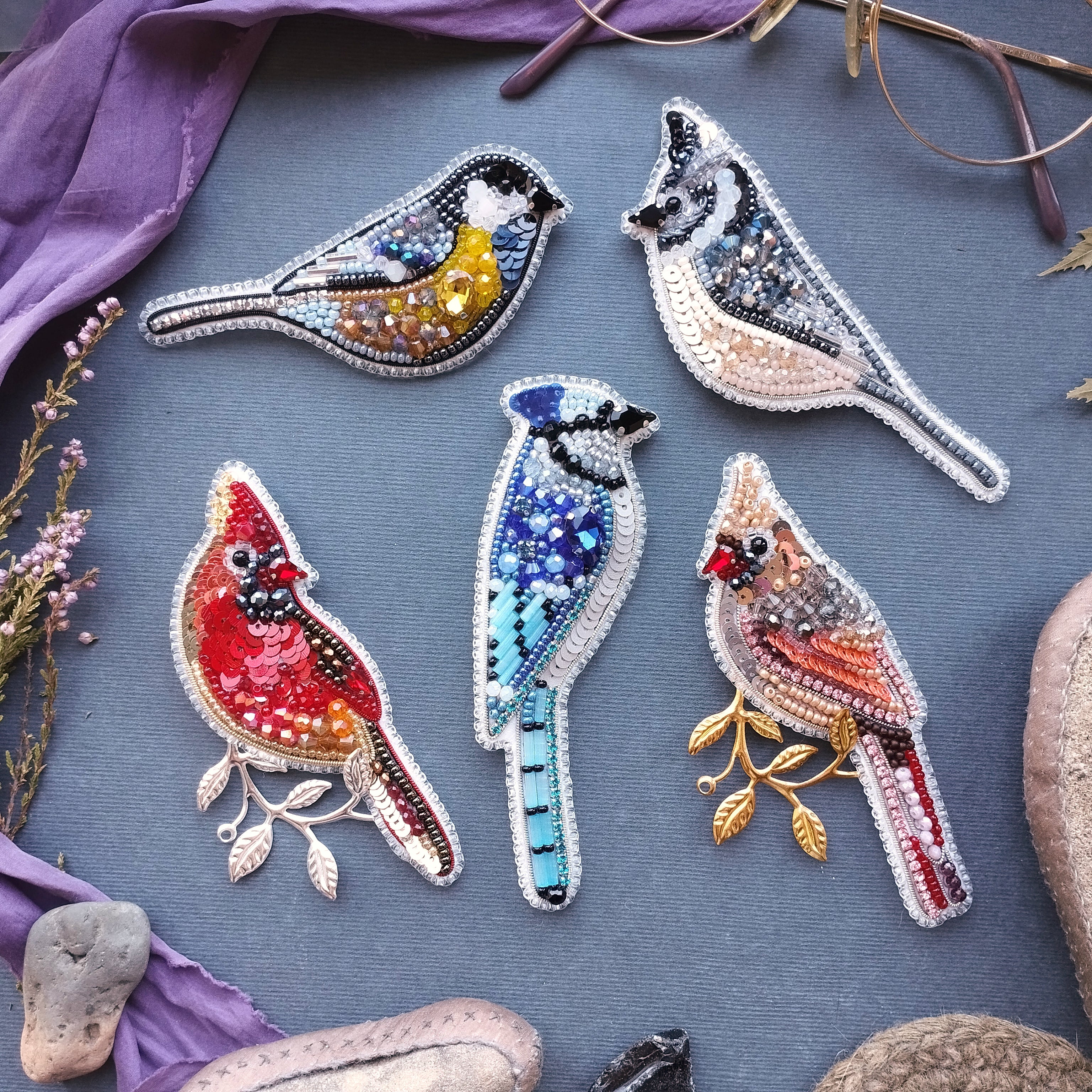
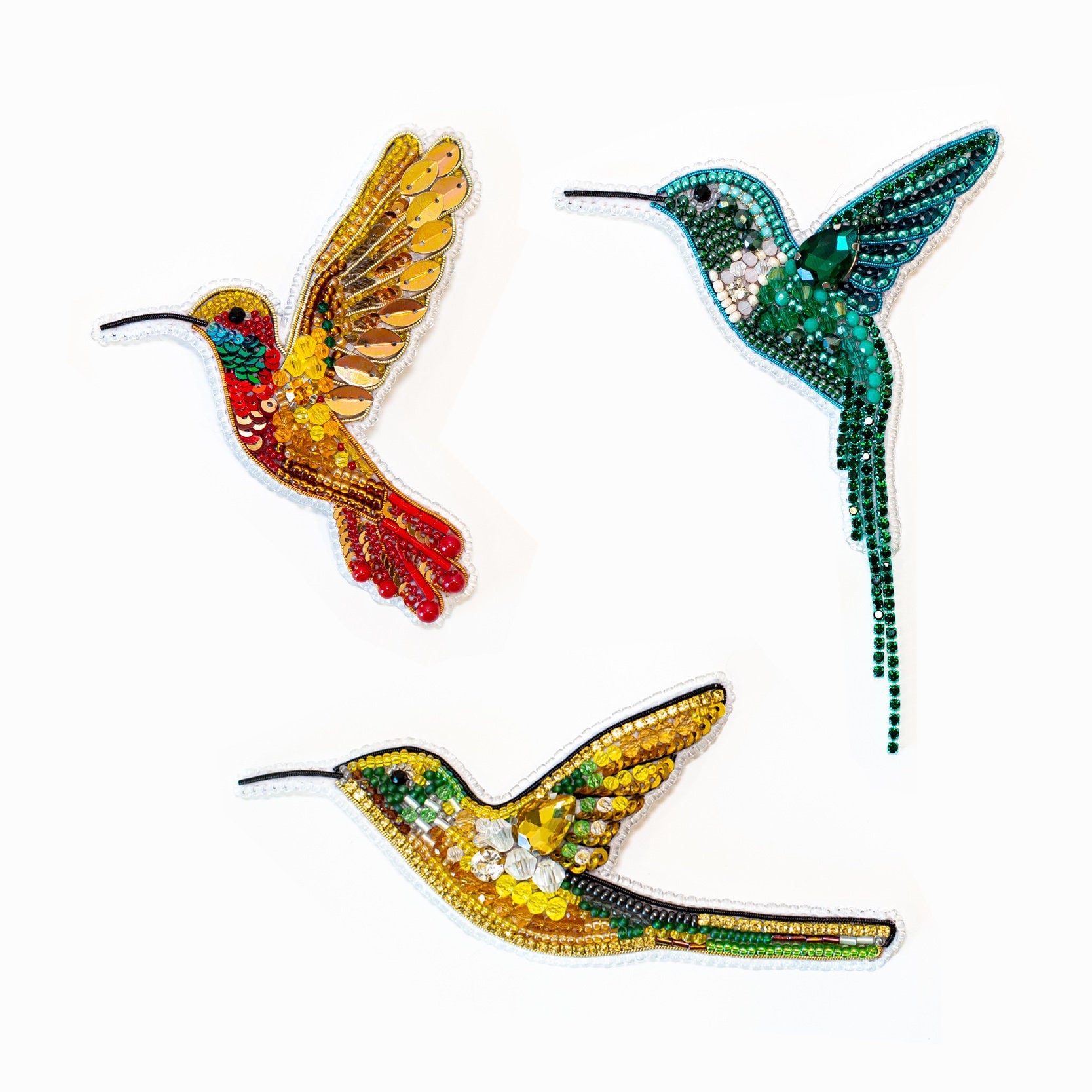


Bugle beads are easy to recognize: instead of the familiar round shape of seed beads, they look like small glass tubes.
But bugle beads are much more varied than they may seem at first. They can be short or long, straight or twisted, smooth or faceted, and they come in many of the same colors and finishes as regular seed beads.
This combination of length, shape and finish makes bugle beads especially interesting for bead embroidery.
What Are Bugle Beads?
Bugle beads are elongated glass beads with a hole running through the entire tube.
Unlike regular seed beads, where size mainly describes the overall diameter of the bead, with bugle beads length becomes an important characteristic.
Some bugles are very short and may look almost like tiny cylinders. Others are several times longer and create a clear line in the embroidery.
This means that choosing bugle beads is not only about finding the right color. You also need to think about how long the bead should be and what kind of line or texture you want it to create.
Different Bugle Bead Shapes
The classic bugle bead is a simple straight, smooth glass tube, but there are many variations.
Depending on the type, bugle beads can have:
Smooth round surface — the classic straight tubular shape
Hexagonal surface — flat outer sides create sharper reflections and a more geometric appearance
Twisted surface — the tube is twisted along its length, creating a spiral effect
Super-twisted surface — a stronger, more pronounced twist that produces even more texture and reflections
The hole itself can also be different. While many bugles have the familiar round hole, some types are produced with square or hexagonal holes.
All these small differences affect the way light moves across the glass. A smooth bugle creates a clean line, while faceted or twisted surfaces produce more sparkle and texture.

Five Standard Bugle Bead Lengths
Another important difference between seed beads and bugle beads is length.
Czech bugle beads are traditionally available in five standard length categories:
1 — approximately 3 mm
2 — approximately 4.5 mm
3 — approximately 7 mm
4 — approximately 9 mm
5 — approximately 12 mm
The longer the bugle, the more pronounced the line it creates in the embroidery.
Short bugles work well for small details and tight curves, while longer ones can cover much more space and create strong directional elements.
Using several lengths in the same design is also an easy way to create rhythm and texture without changing the color.
Colors and Finishes
Just like regular Czech seed beads, bugle beads are available in a huge variety of colors and finishes.
You can find transparent, opaque, silver-lined, metallic, matte, luster, rainbow/AB and other coated finishes.
The important difference is that the elongated shape changes the way these finishes appear.
Transparent glass can create a long line of color and light. Silver-lined bugles are much brighter because the reflective center runs through the entire tube. Matte finishes soften the reflections, while metallic, luster and iridescent coatings make the surface itself more noticeable.
So when choosing bugle beads, look at three things together:
shape + length + finish
Two bugles in exactly the same color can produce completely different effects if one is short and smooth while the other is long, twisted and metallic.
Be Careful With the Edges
There is one important thing to remember when working with bugle beads: the cut edges of the glass tubes can be sharp.
As the embroidery moves and the thread rubs against the edge of the bead, a sharp bugle can gradually damage or even cut the thread.
This does not mean you should avoid bugle beads. They are a wonderful embroidery material — they simply require a little more care.
Avoid pulling the thread unnecessarily hard against the edge of the tube, and pay attention to how the bead sits in the embroidery.
In areas where the thread will experience more movement or tension, it can also help to place a small seed bead next to the end of a bugle. The thread then changes direction around the smoother round bead instead of being pulled directly against the sharp glass edge.
Covering Larger Areas
One of the biggest advantages of bugle beads is their length.
A single long bugle covers an area that would require several ordinary seed beads.
This makes them very useful when you want to fill larger sections of embroidery without creating a completely uniform surface.
But speed is only part of the advantage.
Because every bugle creates a visible line, you can use the direction of those lines as part of the design.
Arrange them parallel to create an orderly surface. Change their direction to create movement. Place them like rays around a central point, or follow the natural shape of a wing, leaf or petal.
Creating Texture and Relief
Bugle beads are especially useful when you want embroidery to have a distinctive texture.
Round seed beads create a surface made of small points. Bugle beads create lines.
Twisted, hexagonal and other shaped bugles add even more texture because their surfaces interact with light differently.
Combining round seed beads with several types and lengths of bugles can make a relatively simple color palette look surprisingly complex.
Instead of adding more colors, you are adding different surfaces, directions and reflections.
More Than Just a Long Bead
It is easy to think of bugle beads simply as elongated seed beads, but their shape gives them very different possibilities.
With ordinary seed beads, we often think about size, color and finish.
With bugle beads, we also need to consider length, shape and direction.
A short smooth bugle, a long twisted bugle and a faceted bugle may all be made from glass and have a similar color — but in finished embroidery they create completely different effects.
That is exactly what makes bugle beads so useful. They can cover space, create clear lines, add sparkle and build unusual relief and texture — all with one simple glass tube.
