
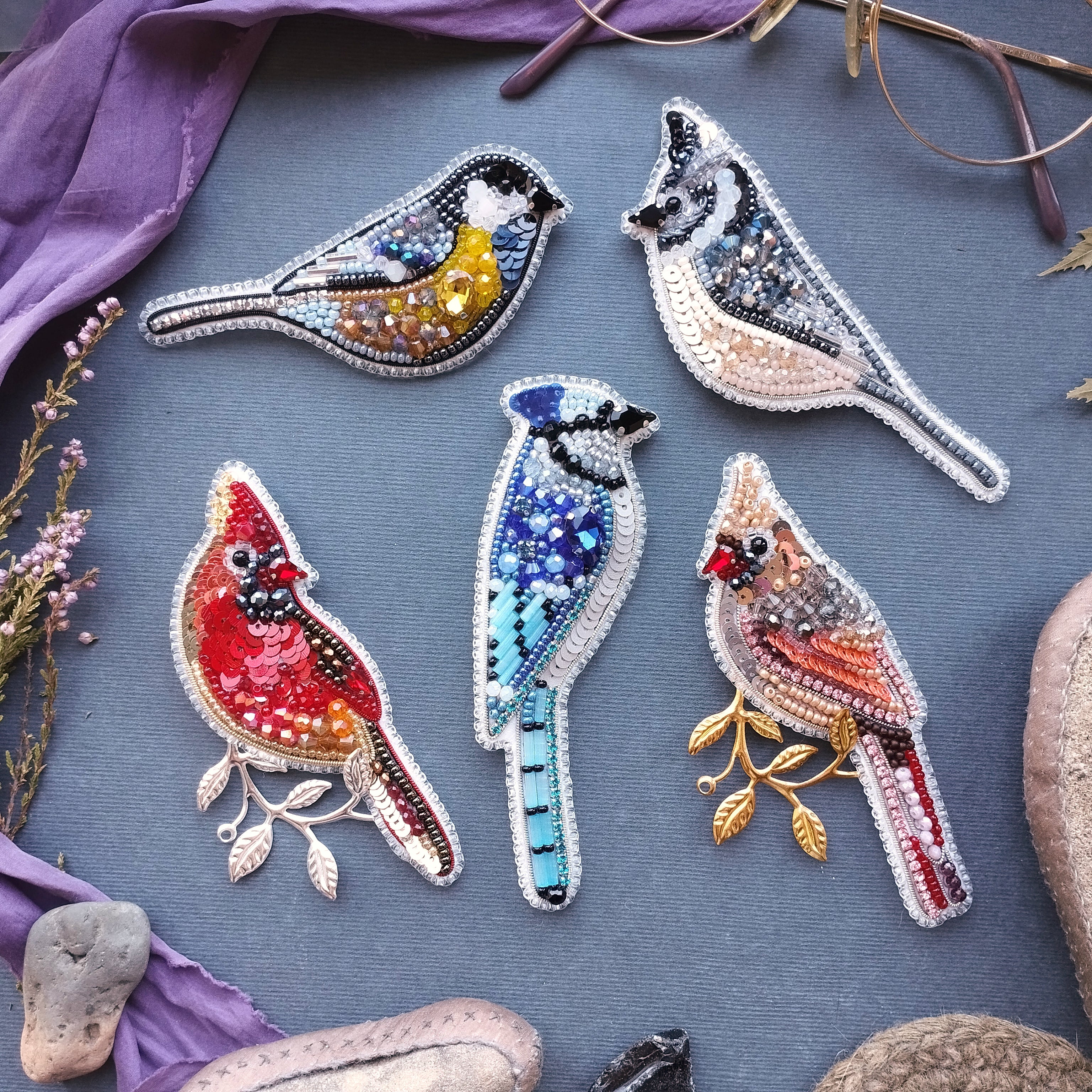
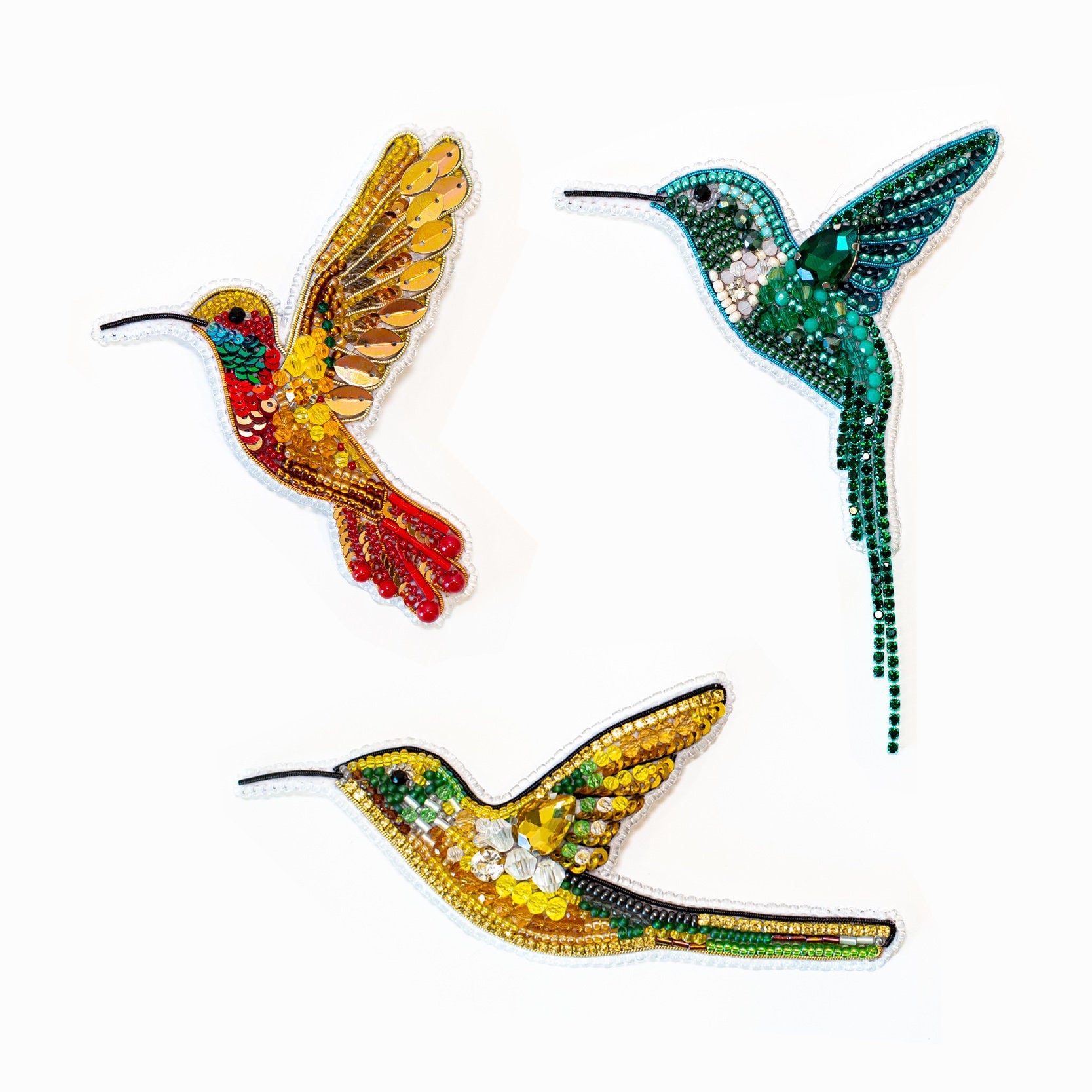


Beads come in an incredible variety of shapes, and knowing their names makes choosing materials for embroidery much easier.
Some beads are simple and familiar, while others may look almost like tiny flowers, drops or crystals. Shape is not only decorative — it affects how a bead reflects light, how much space it takes up and what kind of texture it creates in your embroidery.
Let’s look at some of the bead shapes you will often find in bead embroidery and DIY brooch kits.
Round Beads
Round beads are probably the easiest shape to recognize. They are smooth, spherical beads with a hole running through the center.
They come in almost every imaginable color, size and finish — transparent, opaque, metallic, matte, glossy and many more.
Because of their simple shape, round beads are extremely versatile. They can fill larger areas, create outlines, form small details or simply add volume to a design.
They are also very easy to combine with other bead shapes.
Pearl Beads
Pearl beads have the classic soft glow associated with pearls.
In craft and bead embroidery, the word “pearl” does not necessarily mean a natural pearl. Most pearl beads used in embroidery are glass or other beads with a pearlescent finish.
They can be white and ivory, but also pink, blue, green, gray and many other colors.
Pearl beads create a softer effect than highly faceted or metallic beads. They are especially beautiful when you want a design to look elegant without adding too much sparkle.
Faceted Beads
Faceted beads have multiple flat surfaces cut into them instead of one completely smooth surface.
These facets catch and reflect light, so the bead sparkles as the embroidery moves.
The number, size and arrangement of the facets can vary considerably, which means two faceted beads can have very different appearances.
They are wonderful for adding small points of light and making an embroidered piece look more dimensional.
Rondelle Beads
Rondelle beads are round but flattened — imagine a small sphere gently pressed from the top and bottom.
Many rondelles are faceted, which makes their shape even more noticeable and gives them extra sparkle.
Because they are wider than they are tall, rondelles create a different rhythm when placed next to ordinary round beads. They are useful for adding texture and for separating other beads in a composition.
Small faceted rondelles are especially common in jewelry and bead embroidery.
Bicone Beads
Bicone beads look like two small cones joined together at their widest points.
Their angular shape creates distinct facets that reflect light very well, which is why bicones are often used when a design needs extra sparkle.
They are particularly easy to recognize from the side: instead of a smooth round outline, the bead narrows toward both ends.
Even a few bicone beads can create bright highlights in embroidery.
Oval Beads
Oval beads are similar to round beads but elongated in one direction.
Depending on their proportions, they can be only slightly stretched or noticeably long and narrow.
Their shape makes them useful when you want to create direction in a design. Oval beads can naturally follow the line of a leaf, wing, petal or another elongated element.
They can be smooth, faceted, transparent, opaque or have decorative coatings.
Drop and Teardrop Beads
Drop or teardrop beads are wider at one end and narrower at the other.
There are many variations of this shape. Some are short and rounded, while others are longer and more pointed.
This asymmetrical shape makes drops especially useful for creating natural details: petals, feathers, wings, tails, flower stamens and decorative edges.
They also work beautifully as small hanging elements because the shape naturally draws the eye downward.
Cube Beads
Cube beads have straight sides and a geometric shape that immediately stands out among round beads.
Depending on the design, they may have sharp or slightly softened edges.
Cube beads are useful when you want to introduce a more structured element into embroidery. Even a few cubes among round beads can change the texture and make a small area more visually interesting.
Their flat surfaces can also reflect light differently from smooth round beads.
Shaped and Figural Beads
Not every bead fits into a simple geometric category.
There are beads shaped like flowers, leaves, hearts, stars and many other decorative elements. Some special beads have completely unique shapes designed to represent a particular object or create a specific effect.
We often use these beads as small accents rather than as the main material of the embroidery.
A single flower or leaf bead can immediately suggest what an element represents, while unusual abstract shapes can add texture and make a design more interesting.
These beads are especially fun in embroidery because they allow you to mix traditional beadwork with tiny ready-made decorative details.

Other Bead Shapes You May Come Across
There are many more bead shapes than we could fit into one guide.
You may also encounter rice beads, which are elongated like grains of rice; lentil beads, which are flat and rounded; coin or disc beads, which resemble small flat circles; and dagger or spike beads, which have long pointed shapes.
Another common type is the fire-polished bead. This term describes a traditional Czech glass bead whose facets are softened and polished by heat. Fire-polished beads are available in different shapes and sizes and are known for their distinctive softer sparkle.
We don't use all of these bead types regularly in our kits, but knowing the names can make shopping for materials and following embroidery instructions much easier.

Shape Changes the Design
When choosing beads, it is easy to focus only on color. But shape can change the embroidery just as much.
A round bead creates a soft point of color. A faceted bead catches the light. A bicone adds sharper sparkle. A drop immediately introduces direction, while a cube adds a small geometric accent.
Combining several shapes is one of the easiest ways to make bead embroidery look rich and detailed without using an enormous number of colors.
So when you look at your next embroidery project, don't just ask, “What color do I need?”
Take a closer look at the shape too. Sometimes changing the shape of just a few beads is enough to completely change the character of the finished piece.

